Table Of Content
She supported trade unions and strikes but rejected anarchists and the militant Industrial Workers of the World. Skeptical of socialism, she repeatedly criticized the excesses of capitalism. Always, Jane Addams was an unwavering suffragist, connecting the vote to improving the lives of the families in the Nineteenth Ward. Witnessing the damage alcohol did to families in her ward, she remained a convinced prohibitionist.
National Endowment for the Humanities
Addams had a heart attack in 1926 and remained unwell for the rest of her life. Thousands of people attended her funeral in the courtyard of Hull-House. She is buried in her family’s plot in Cedarville Cemetery in Cedarvillle, Illionis. Jane Addams was born in Cedarville, Illinois on September 6, 1860 to Sarah Adams (Weber) and John Huy Adams. She was the eighth of nine children and was born with a spinal defect that hampered her early physical growth before it was rectified by surgery.
Meadow Brook Hall
Others study her oratory, writing style, and changing religious beliefs. Elected head of the newly formed Women’s Peace Party in 1915, Addams traveled to The Hague in the spring of 1915 to preside over an international conference made up of delegates from both warring and neutral nations. With some of the delegates, she then traveled to the warring nations, meeting foreign ministers, visiting wounded soldiers and grieving mothers, and absorbing the carnage ruining Europe. Returning to the U.S. in July 1915, she spoke to a peace rally at Carnegie Hall before a largely friendly audience of three thousand people. She ended her speech describing the way liquor was doled out to soldiers before bayonet charges. Her first book, Democracy and Social Ethics, which James admired, emphasizes such phrases as social equality, moral idealism, civic virtue, association, industrial amelioration—all words and ideas she repeated in her subsequent books.
National Trust for Historic Preservation
Chicago migrants: City's history has a blueprint for handling immigration challenge - Chicago Sun-Times
Chicago migrants: City's history has a blueprint for handling immigration challenge.
Posted: Mon, 10 Jul 2023 07:00:00 GMT [source]
She expressed her opposition to viewing the neighborhood as a laboratory, emphasizing that Hull-House aimed to assist the neighbors rather than study them.[26] However, she ended up becoming a sociologist. Faderman describes Jane as "probably the first to take the work of female social scientists seriously."[27] She was one of the founding members of the American Sociological Association, established in 1905. Additionally, she lectured on sociology at both the University of Chicago Extension and the Chicago School of Civics and Philanthropy. The Urban Experience in Chicago site is clearly focused on the physical and historical context of Hull House in its urban environment as well as the role that Addams and other women played in the settlement movement and in Chicago. It is a rich resource for academic historians, casual students of history, teachers, and high school students. The site takes advantage of the online medium by being fully searchable and allowing users to control the depth to which they explore subjects, either by clicking through the essays or returning to the top navigation bar.
Thorstein Veblen eviscerated the idle rich and coined the phrase “conspicuous consumption” in The Theory of the Leisure Class. Julia Lathrop, whom Addams had met at the Rockford Female Seminary, organized a discussion group, the Plato Club. Recognizing a more urgent need—children in jail—Lathrop helped found the country’s first juvenile court.
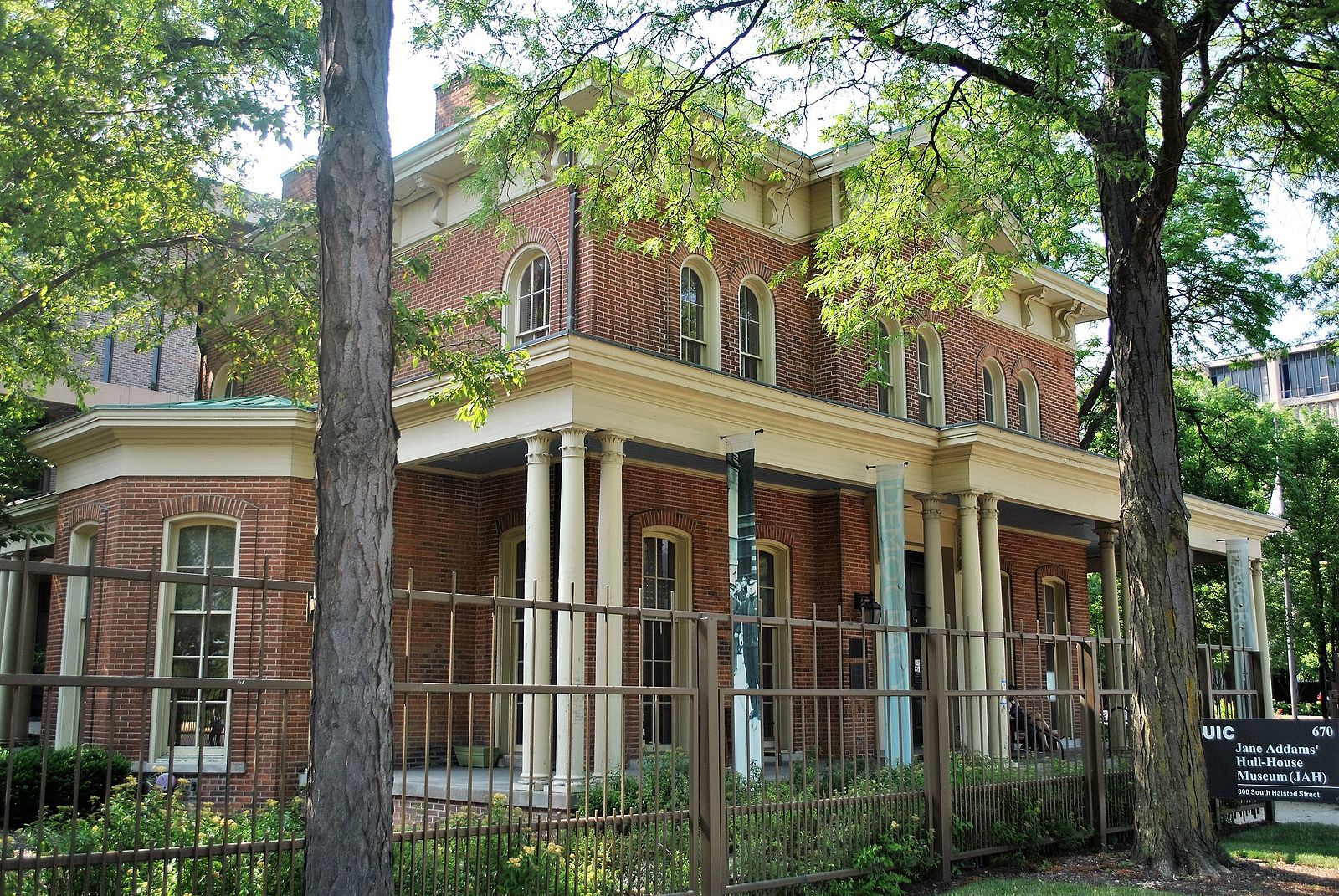
Hull-House has long been a center of Chicago’s political and cultural life, establishing Chicago’s first public playground and public art gallery, helping to desegregate the Chicago Public Schools, and influencing philanthropy and culture. Jane's perspective aside, Hull-House represented a form of experimentation. By 1900, nearly 100 settlement houses akin to Hull-House had emerged across the United States. Residency fostered the investigation of neighborhood conditions and Hull-House residents explored child labor, tenement conditions, ethnic groups, infant mortality, midwifery, cocaine use, and the causes and prevention of truancy. Many of their findings were published in the American Journal of Sociology. They used this information to lobby for reforms that would counter the conditions found in their neighborhood.

You Can Still Die From World War I Dangers in France's Red Zones
The site is not terribly dynamic, however, and how it functions as an “on-going research project” is unclear. It appears to have been conceptualized as an online book, with an introduction, site credits, and a home page that functions as a table of contents. The use of a splash page that necessitates clicking “Enter” to access the site may deter casual visitors. The site would also be enhanced by adding “title tags” to the photographs (that is, text that displays when a mouse is held over the image).
Futaba Cake Building
"They grew up to be lawyers and mechanics, sewer workers and dump truck drivers, a candy shop owner, a boxer and a mob boss." Jane Addams death in the spring of 1935, after surgery to remove an intestinal blockage caused by cancer, led to a crisis at the settlement. Louise deKoven Bowen became the new President of the Hull-House Board and a committee of residents ran the settlement while a successor was chosen.
Community
There are biographies for scholars, for the general reader, for young adults, and for children. At National History Day, a popular competition for middle and high school students supported by NEH, Jane Addams is a favorite subject. In her own time, the celebrated advocate of the poor was famous, then scorned, and, finally, reconsidered and elevated to the pantheon of American heroes. The complex expanded to include thirteen buildings and supported clubs and activities such as a Labor Museum, the Jane Club for single working women, meeting places for trade union groups, and a wide array of cultural events. A historic picture, "Meet the Hull House Kids," was taken on a summer day in 1924 by Wallace K. Kirkland Sr., Hull House Director. The twenty Hull House Kids were erroneously described as young boys, of Irish ancestry, posing in the Dante School yard on Forquer Street (now Arthington Street).
She is probably best known as a co-founder of Hull House in Chicago, one of the first social settlements in North America. Sociologist Erik Schneiderhan notes the striking parallels between Addams and Barack Obama, who has cited “Jane Addams toiling in a Chicago settlement home” as an inspiration. A young, idealistic Obama sought purpose as a community organizer on Chicago’s South Side as did Jane Addams in the Nineteenth Ward. Each wrote books and was a privileged intellectual with a social conscience. This all changed in 1914 with the start of World War I. Her dream of increasing internationalism and declining militarism was shattered. “From the first word to the last,” her niece remembered, “she held the complete attention of her audience.” A woman of conviction, Addams was also a politician and compromiser.
Three sections accessed from the top navigation bar are image based, including a timeline of Jane Addams’s biography and a selection of fully documented photo essays on the Hull House complex and the neighborhood. A “Geography” section offers a graphic representation of how the complex grew from one building to thirteen and displays the famous 1895 Hull House nationality maps, among others. Finally, a “Teachers' Resource” section offers lesson plans on Hull House during the Progressive Era, children’s play space in nineteenth-century Chicago, and Addams’s Twenty Years at Hull-House (1912). The NWSPB's plans for the neighborhood had already been challenged, however. Returning GIs had put a severe strain on the temporary campus established by the University of Illinois at Navy Pier in 1946.
After the armistice she helped found the Women’s International League for Peace and Freedom, serving as president from 1919 until her death in 1935. Addams was the first woman president of the National Conference of Social Work. A pacifist, she served as president of the International Congress of Women in 1915 and founded the Woman’s Peace Party, the predecessor to the Women’s International League for Peace and Freedom. No longer just a saint and social worker, scholars now praise Addams as an intellectual and theorist. Her 11 books, hundreds of articles and reviews, and thousands of letters offer academics abundant material for commentary and debate. Some see her as a pioneering sociologist, a contributor to John Dewey’s educational thought and to William James’s pragmatic theory.


No comments:
Post a Comment